"Howard's is a voice of undeniable poise and power" - The Arts Desk
"seethes with invention" - BBC Music Magazine
"energetic impact and imaginative breadth" - The Wire
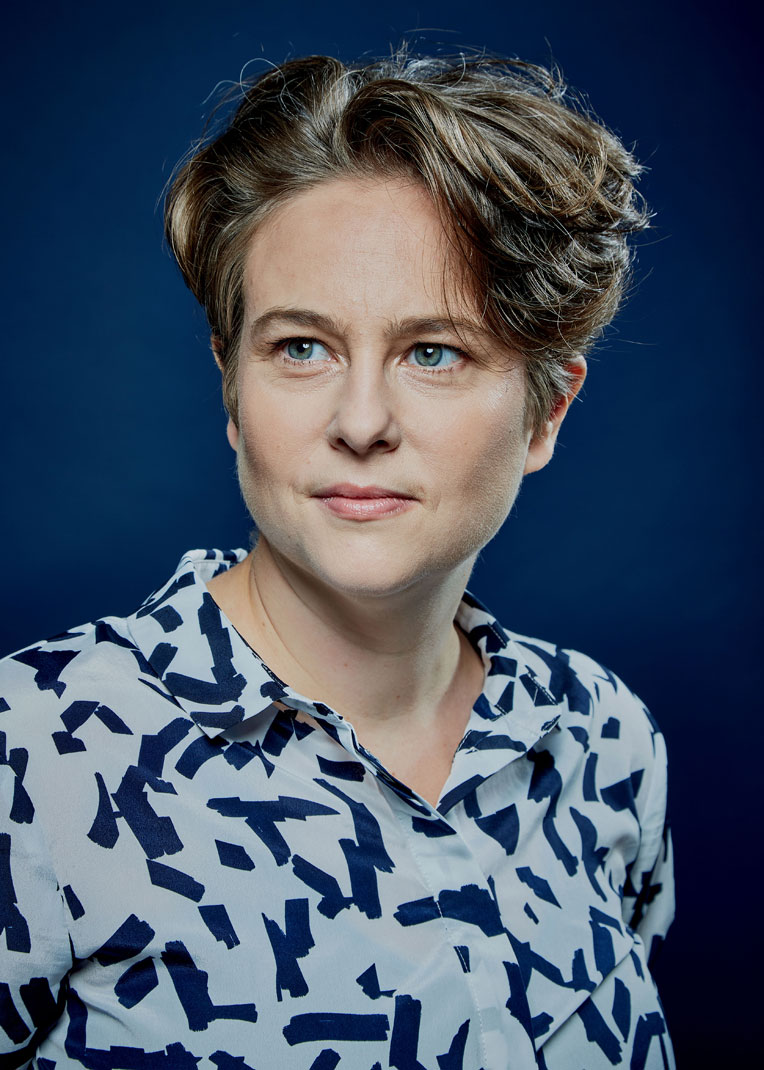
Emily Howard is one of the UK's most exciting and strikingly individual composers, writing music that is notable for its rich, expansive orchestral textures, imaginative use of instrumental colour, and powerful use of text. Howard's works often take their inspiration from the shapes, structures, and phenomena of the natural world, as well as from literature, politics, and the visual arts. .
From the visceral impact and emotion of The Anvil (2019) - a compelling and spectacular work scored for a large orchestra and chorus, commissioned to mark the Peterloo Massacre bicentenary and recorded by the BBC Philharmonic, BBC Singers, Hallé Choir, Hallé Youth Choir and Hallé Ancoats Community Choir (2023; Delphian) - to the atmospheric and crystalline sound-world of Magnetite (2007), widely performed across the world, Emily Howard's distinctive musical language is beautifully expressive, whilst also conveying a searing intensity and focus where every note and phrase is placed with care.
Described as possessing “some remarkable sonorities and an apocalyptic sense of drama” (Classical Source), Howard 's Antisphere (2019), commissioned by the Barbican for Sir Simon Rattle and the London Symphony Orchestra, is “a warping and melting of harmony and rhythm, in which intervals collapse into one another, in which time is shrunk and stretched” (Tom Service, BBC Radio 3 New Music Show).
Another of Howard's geometry-inspired works is the 2016 BBC Proms commission Torus (“visionary”, The Times), which was the orchestral winner at the 2017 British Composer Awards and has been recorded by the BBC Symphony Orchestra and Martyn Brabbins (2023; NMC).
A fascination with the raw power of the human voice, and a desire to explore its full potential through the extremities of both pitch and dynamic range can be heard in Howard's vocal works such as Elliptics (2022), a meditation on love and death, and what we hope will survive; and the sci-fi chamber opera To See The Invisible (2018), commissioned by and premiered at Aldeburgh Festival.
Howard is Professor in Composition and Head of Artistic Research at the Royal Northern College of Music, and is a founder-director of PRiSM, the Royal Northern College of Music 's Centre for Practice & Research in Science & Music, dedicated to understanding what it means to be human and creative today.
Emily Howard has received two BASCA British Composer Awards, recognition from the Paul Hamlyn Foundation, and in 2023 was elected as an Honorary Fellow of the Royal Academy of Arts, one of only a handful of composers to ever hold this title.
Howard is represented by Cathy Nelson Artists & Projects, and her music is published by Edition Peters, part of Wise Music Group. Visit Emily Howard 's Wise Music page here.